What a hackathon platform actually costs
Pricing is the hardest part of choosing hackathon software — because most vendors don't publish it. You'll find "Request a demo" buttons where the price should be, plans quoted per seat, and enterprise contracts that only make sense at thousands of participants. For a small organizing team running one or two events a year, that opacity is the whole problem.
This guide compares how the major hackathon and game jam platforms price in 2026 — the model, not just a number — so you can budget realistically before you commit to anything.
Full disclosure: this is HackathonHost's blog, and HackathonHost uses a flat per-event price (more on that below). We've kept the comparison about pricing models, which are public and verifiable, rather than guessing at numbers vendors don't list — always confirm current pricing on each vendor's own site.
Pricing models, at a glance
| Platform | Pricing model | Free option | Public pricing? | Best fit |
|---|---|---|---|---|
| HackathonHost | Flat price per event | Free drafts | Yes — on the pricing page | Hackathons & game jams, small teams, white-label |
| Devpost | Sponsor / enterprise (custom) | Free for participants | No — custom quote | Large public hackathons |
| HackerEarth | Enterprise / custom quote | Free trial / demo | No — sales-led | Hiring-driven enterprise hackathons |
| Devfolio | Free for organizers (ecosystem-funded) | Yes | Yes (free) | Community & web3 hackathons |
| itch.io | Free to host (optional revenue share) | Yes | Yes (free) | Free, community game jams |
| Eventornado | Freemium / subscription tiers | Limited free tier | Partially | General hackathons & innovation programs |
| Agorize | Enterprise / custom | No | No — sales-led | Large corporate innovation challenges |
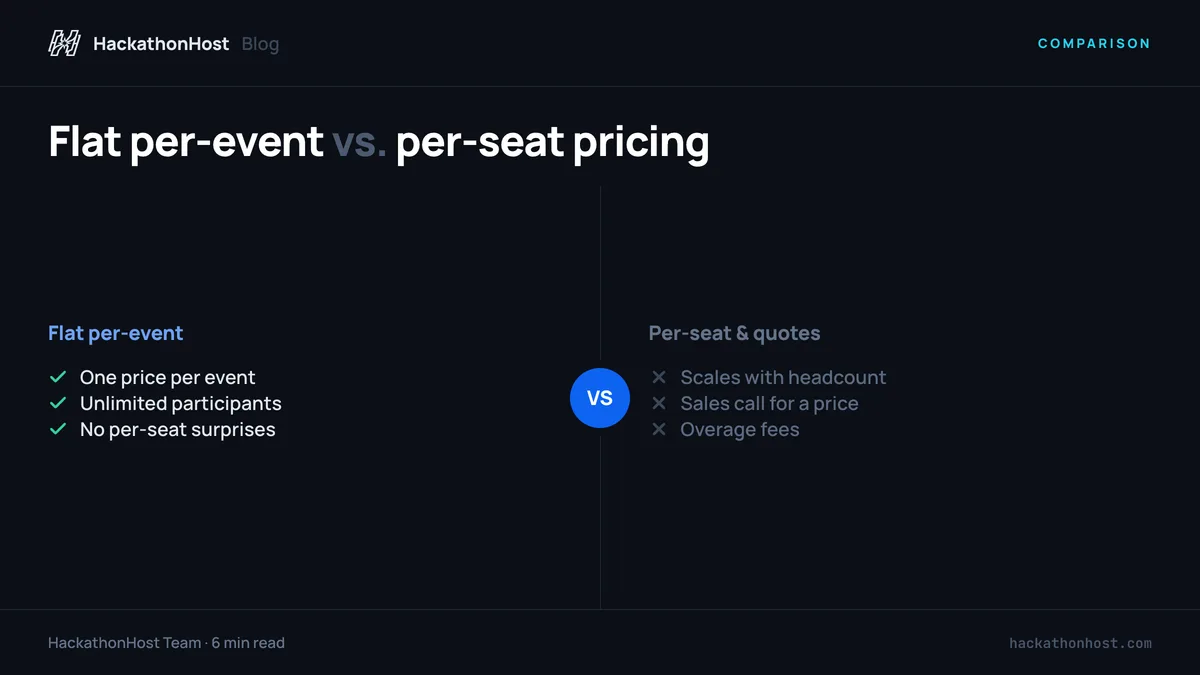
The single most important column here is "pricing model" — it predicts how your bill scales. A per-seat plan gets more expensive the more successful your event is; a flat per-event price doesn't.
The platforms, by how they charge
HackathonHost — flat price per event
HackathonHost charges a flat price per event: no subscription, no per-seat or per-participant fees, and no enterprise sales call. You pay for the events you actually run — a 30-person internal hackathon and a 300-person game jam are the same simple model — and the price is listed publicly on the pricing page. It's also fully white-label, so participants see your brand, not ours.
Pay for: the event. Best for: small teams running hackathons or game jams who want a professional, branded event without an enterprise budget.
Devpost — custom, sponsor-funded
Devpost is free to join as a participant, but hosting an organizer/enterprise hackathon is custom-priced and oriented toward sponsor-backed, high-reach events. There's no public price list — you'll get a quote.
Pay for: reach and scale. Best for: large public hackathons with a sponsor budget.
HackerEarth — enterprise, sales-led
HackerEarth bundles hackathon hosting with coding assessments and a hiring pipeline. Pricing is enterprise and sales-led — a custom quote tied to its recruiting suite — so it's priced for companies using hackathons to hire, not for a community jam.
Pay for: technical hiring tooling. Best for: hiring-driven enterprise hackathons.
Devfolio — free for organizers
Devfolio is free for organizers, funded through its ecosystem and sponsor integrations rather than an organizer fee. That's a great deal if your event lives in its community (student and web3 hackathons), with the trade-off of less standalone white-label control.
Pay for: nothing directly (ecosystem-funded). Best for: community and web3 hackathons.
itch.io — free to host
itch.io is free to host a game jam, with ranked jams and community or judge voting. It's hard to beat on price for a casual jam. The trade-off is that it's a submission-and-voting page, not an event-management tool — no real registration, weighted jury workflow, certificates, or branding.
Pay for: nothing to host. Best for: free, public game jams.
Eventornado — freemium / subscription
Eventornado offers a limited free tier plus paid subscription/per-event plans for larger hackathons and innovation programs. Some pricing is published; bigger needs move to a quote.
Pay for: a subscription or per-event plan. Best for: general hackathons and ongoing innovation programs.
Agorize — enterprise innovation
Agorize runs large open-innovation and corporate challenge programs with custom enterprise pricing and no public price list. It's built for big brand challenges, not weekend events.
Pay for: a managed enterprise program. Best for: large corporate innovation challenges.
How to read hackathon pricing (without getting burned)
The headline number matters less than the model. Three traps to watch for:
- Per-seat / per-participant fees. These punish you for a successful event — a jam that doubles its sign-ups doubles your bill. Fine at small scale, painful at large.
- "Contact sales" enterprise pricing. Often means long contracts, onboarding fees, and a price set by how big you look. Great for enterprises; overkill for a community event.
- Year-round subscriptions. If you run two events a year, paying twelve months of subscription is poor value.
For most organizers, a flat price per event is the friendliest model: predictable, no surprises, and you only pay when you actually run something. Before you decide, run any tool through our buyer's checklist — pricing is the last row for a reason: it only matters once a tool clears the feature bar.
FAQ
Is there a free hackathon platform? Yes. itch.io is free to host game jams, and Devfolio is free for organizers of community and web3 hackathons. The trade-off is limited registration, judging, branding, and certificate tooling compared with a paid, organizer-focused platform.
How much does a hackathon platform cost? It depends entirely on the model. Free for community tools; a flat per-event fee for organizer-focused platforms like HackathonHost (listed on the pricing page); and custom, sales-led quotes for enterprise/recruiting platforms like HackerEarth, Devpost, and Agorize.
What's the cheapest way to run a professional, branded hackathon? A flat per-event platform. You avoid per-seat fees and year-round subscriptions, pay only for the events you run, and still get registration, weighted judging, white-label branding, and certificates.
Do these platforms charge per participant? Some do. Per-seat or per-participant pricing scales your cost with attendance, so confirm the model before a big event — a flat per-event price avoids that entirely.
Which platform is best value for a small team? If you run hackathons or game jams with a 1–2 person team and want your own branding, a flat per-event tool is usually the best value. That's exactly what we built HackathonHost for — see the full platform comparison.
The bottom line
Don't compare hackathon platforms on price alone — compare on pricing model, because that's what determines your bill as the event grows. Free tools (itch.io, Devfolio) are unbeatable for casual community events; enterprise suites (HackerEarth, Devpost, Agorize) make sense when hiring or massive reach is the point. For a small team running a professional, branded hackathon or game jam end-to-end, a flat per-event price is the most predictable — see what HackathonHost costs and the full best-platforms comparison.
New to organizing? Start with organizing a hackathon: tasks list & tips, how to run a game jam, or the buyer's checklist.