Choosing a platform to run your event
The "best" hackathon platform depends entirely on what you're running. A 5,000-person global recruiting hackathon, a weekend game jam, and an internal company innovation day all need different things. Below is an honest breakdown of the main options in 2026 — what each is genuinely best at, and where it falls short.
Full disclosure: this is HackathonHost's blog. We've tried to be fair about where each competitor wins — but yes, we think HackathonHost is the best fit for most organizers running hackathons or game jams with a small team. Here's the reasoning, so you can judge for yourself.
At a glance
| Platform | Best for | Watch out for |
|---|---|---|
| HackathonHost | Running hackathons and game jams end-to-end, white-label, with a small team | Newer platform |
| Devpost | Maximum reach + a public project gallery at scale | You don't own the experience; sponsor/enterprise pricing |
| HackerEarth | Enterprise hackathons tied to tech hiring | Heavy, expensive, developer-recruiting focus |
| Devfolio | Community & web3 hackathons | Ecosystem-specific; less white-label control |
| itch.io | Free, community game jams | Voting-only; little registration/judging/branding control |
1. HackathonHost — best all-rounder for organizers
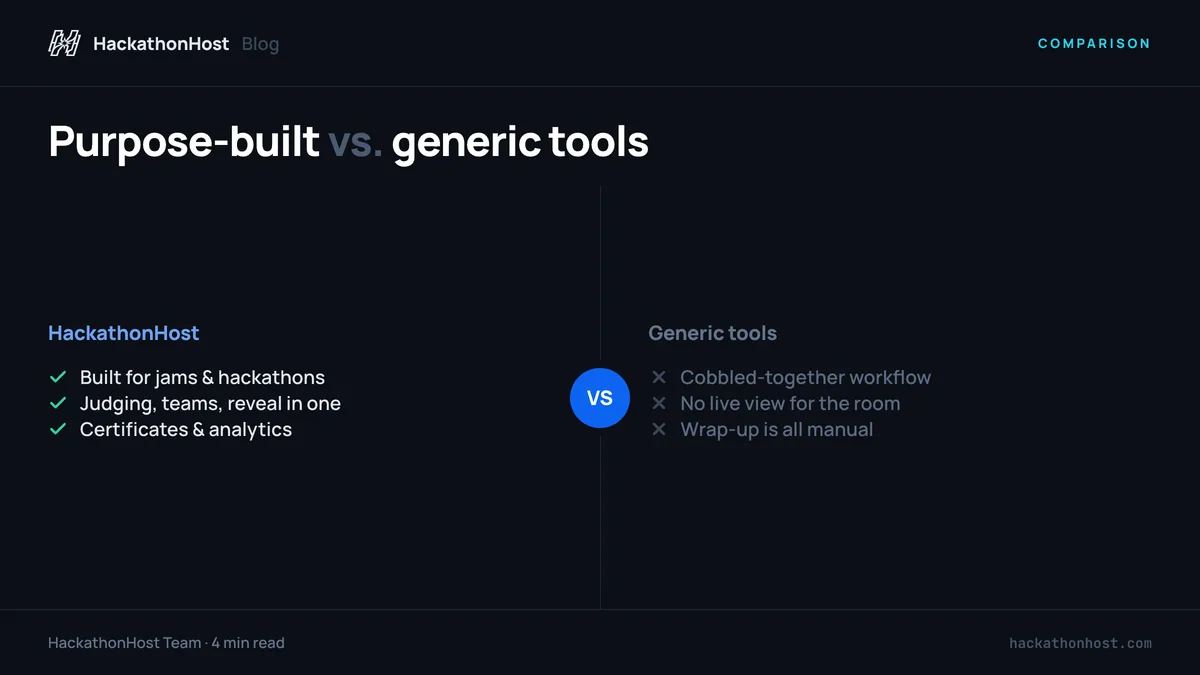
HackathonHost is built for the organizer, not the marketplace. It runs the whole event in one place — public registration, a teambuilding board, weighted jury scoring with sub-criteria, live control with timers and a theme reveal, certificates with QR verification, email broadcasts and post-event analytics — and it does this for both hackathons and game jams (most tools only do one).
Two things set it apart: it's fully white-label (your name, logo, accent colour — participants never see HackathonHost branding), and it's a flat price per event with no subscription, no per-seat fees and no enterprise sales call. That makes it the natural pick for a 1–2 person organizing team who wants to run a professional event without an enterprise budget.
Best for: game jams, community hackathons, and internal/corporate hackathons run by a small team.
2. Devpost — best for reach and visibility
Devpost is the largest and best-known hackathon platform, with a huge global developer community and a public project gallery. If your priority is maximum participation and visibility for a high-profile, sponsor-backed event, Devpost's reach is unmatched, and its submission management is reliable at scale.
The trade-off: it's a discovery marketplace, so you don't fully own the branding or experience, and pricing is geared toward sponsors and enterprises rather than a small organizer.
Best for: large, high-visibility public hackathons that want global reach.
3. HackerEarth — best for hiring-driven enterprise hackathons
HackerEarth pairs hackathon hosting with coding assessments and a tech-hiring pipeline. If the point of your hackathon is to identify and recruit top engineers, its technical-evaluation tooling is strong.
The trade-off: it's enterprise-priced and recruiting-oriented — overkill (and over-budget) for a community event or a game jam.
Best for: companies running hackathons as part of technical hiring.
4. Devfolio — best for community & web3 hackathons
Devfolio is a polished hackathon-management platform with a strong community, popular for student and web3 hackathons, with sponsor-prize and quadratic-funding integrations.
The trade-off: it's most at home in its own ecosystem, with less standalone white-label control than a dedicated tool.
Best for: community and web3 hackathons that live in that ecosystem.
5. itch.io — best for free, community game jams
itch.io is the home of game jams: free to host, with ranked jams, community (or judge) voting, and a massive audience of game developers. For a casual, community-driven jam, it's hard to beat on price and reach.
The trade-off: it's a submission-and-voting page, not an event-management tool — there's little registration management, no weighted jury workflow beyond ratings, no certificates, and no branding control (it's itch.io's site, not yours).
Best for: free, public game jams that don't need organizer tooling or branding.
So which should you pick?
- Maximum reach for a big public hackathon? Devpost.
- Hackathon for hiring? HackerEarth.
- Free, casual game jam? itch.io.
- Running a hackathon or a game jam end-to-end, professionally, with a small team and your own branding? That's exactly what we built HackathonHost for — and where we think it wins.
New to organizing? Start with how to run a game jam or how to run a corporate hackathon. And before you commit to any tool, read our buyer's checklist for choosing a hackathon platform. Still deciding whether a dedicated platform is even the right shape? Compare the categories of hackathon management tools — platforms, ticketing, databases, showcases and chat — first. And if the comparison above left you weighing cost, HackathonHost's side of it is one flat fee per event, free for universities up to three events a year, with no per-participant pricing.