A hackathon looks effortless from the participant side: register, find a team, build something, pitch it, wait for the winners. Behind that, organizers are usually juggling forms, spreadsheets, chat threads, slide decks, timers, scoring sheets and last-minute emails.
The phrase hackathon hosting service covers three genuinely different things, and most comparison guides blur them together. You can license a self-serve platform and run the event yourself. You can pay for managed hosting, where the vendor configures and operates the platform with you. Or you can hire an agency to produce the whole thing. They carry different costs, different failure modes, and very different amounts of your team's time.
This guide compares those three models and what each should be held to. If you already know you want to run it yourself and just need to pick a product, the platform-by-platform comparison is the more direct read.
The three hosting models
1. Self-serve hackathon platforms
You license software, configure it, and run the event with your own team. Devpost, Devfolio, TAIKAI, itch.io and HackathonHost all sit here, though they aim at different audiences — public developer reach, web3 communities, game jams, and white-label organizer control respectively.
This is the right default for most organizers. It is the cheapest model, it keeps event knowledge inside your team, and modern platforms have absorbed enough of the operational work that a two-person team can run a 300-person event. The trade-off is that setup, communication and event-day operations are yours.
2. Managed hosting on a platform
The vendor sets the event up, configures judging, and stays on call during the event. You still own the brand and the participant relationship, but you are not the one clicking through the reveal at 9 p.m.
This suits flagship or first-time events where the stakes are high and the internal team is thin. Ask precisely what "managed" includes: setup only, or event-day operations too? Named contact, or shared queue? Coverage across your actual event hours, including overnight?
3. Event agencies
An agency produces the event end to end — venue, sponsors, marketing, production, sometimes the platform choice as well. It is the most expensive option and the most complete one.
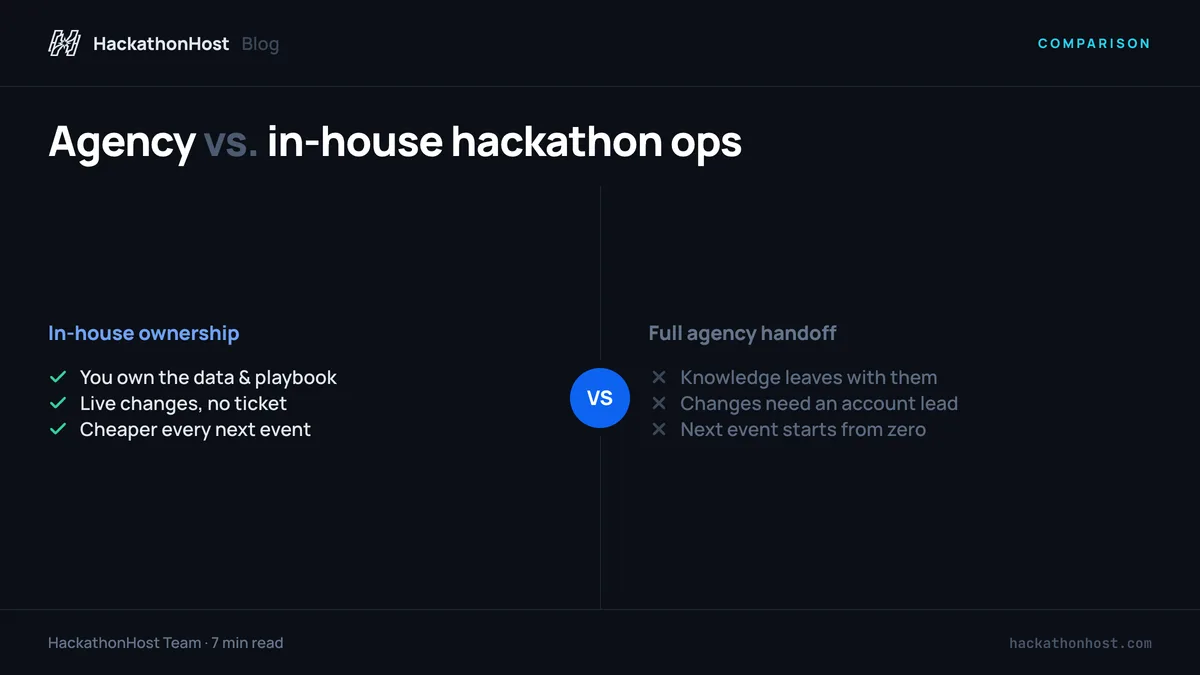
The risk is that event knowledge and the participant relationship leave with the agency when the contract ends. If you plan to run this program annually, that matters more than the invoice. We covered the full trade-off in agency versus in-house, including the hybrid split that usually works best.
Start with the event you actually run
Generic event platforms handle tickets, agendas and attendee lists. Those are useful basics, but hackathons, game jams, demo days and innovation challenges create different operational pressure. Participants form teams, mentors need to be discoverable, submissions arrive under deadlines, pitches run on a clock, and judging needs to stay fair even when one judge scores more harshly than another.
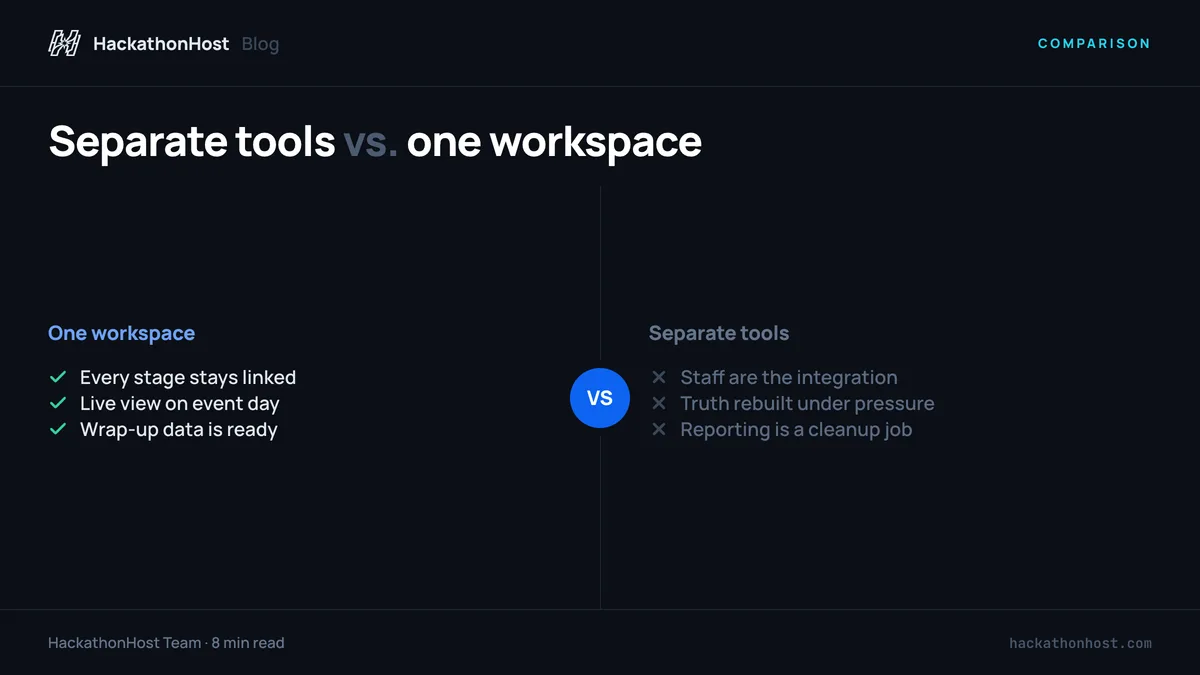
If a service expects you to bolt together a form builder, shared drive, polling app, timer and score spreadsheet, it is not removing the work. It is moving the work between tabs.
The right service should also support your format. A university weekend hackathon needs capacity controls, team matching and a reliable results reveal. A studio running a game jam may need theme reveals, mentor specialties, strike tracking and public voting. An accelerator demo day cares more about scoped juries, weighted criteria, pitch timing and polished stakeholder reports.
What to demand before the event opens
The first test is setup speed. A strong service lets you launch a branded registration experience without involving a developer. Your logo, colors, event name, emails, tickets, certificates and participant-facing pages should belong to your organization — white-label delivery protects trust and makes the event feel like a program you own rather than a campaign on someone else's platform.
Registration should be more than a name-and-email form. Look for custom intake fields that collect what you actually need — skill areas, experience level, dietary needs, preferred roles, consent requirements — plus built-in capacity limits and waitlists. When demand shifts, nobody should be reconciling a list across three systems.
Team formation is the clearest dividing line. Many organizers accept that solo participants need help finding collaborators, then try to solve it with a chat channel. That works for a group of friends. It fails when newcomers arrive, skills cluster unevenly, and participants spend the first hour looking for a team instead of building. A team-building board that matches solo participants into balanced teams gives them a path into the competition without constant organizer intervention.
Finally, check how the service treats data. If you are collecting participant information on behalf of an institution or client, tenant-isolated data, participant self-service access and erasure, and a clear data processing agreement reduce risk and prevent awkward cleanup later.
What to demand on event day
Live events expose every weak handoff. A registration list can be correct at 9:00 a.m. and wrong by 9:15. A pitch order changes, a team swaps members, a mentor drops out, a judge asks where the rubric is.
Look for a live control console designed for the room, not just for an administrator at a desk: pitch timers, full-screen projector views, and a clear run-of-show. When presentations start, your team should be operating the program, not hunting for the right browser tab. QR check-in and wallet tickets cut the queue at the door and make the first interaction feel professional. For hybrid events, the same clarity has to hold online — one place for schedules, mentors, submissions, voting and announcements.
Public polling can add energy, but it should be optional and controlled. A crowd-choice award complements expert judging. It is a poor substitute for it when the prize depends on technical merit or business impact. If you want the operational view of this, see event dashboards for hackathons.
Judging is the part that protects your reputation
Judging is where a polished event loses credibility. A basic score form collects numbers but does not solve inconsistent judging behavior. One juror treats seven out of ten as strong; another reserves high scores for exceptional work only. Without normalization, the harsh judge has more influence than intended.
The stronger services support weighted criteria and normalized jury scoring. Weighting lets you decide what matters most — technical execution, creativity, impact, presentation, theme fit. Normalization balances harsh and lenient patterns so results reflect the panel rather than a single grader's habits.
None of that means hiding the rules. Give judges a clear rubric, define the scale, and decide how ties, penalties, conflicts of interest and absent teams are handled before judging opens. For larger events, room-scoped juries keep each judge on their assigned projects instead of an unmanageable list.
HackathonHost sits in the self-serve category and brings these competition-specific workflows into one white-label workspace — weighted scoring, normalization, submission controls, live pitch tools and scheduled reveals. The point is not more software. It is removing the fragile handoffs that make organizers second-guess a result.
Price the whole stack, not the registration page
A low entry price misleads when it excludes the workflows that create the most work. Per-participant fees rise with a successful event. Per-email charges punish communication. Monthly subscriptions are hard to justify for a team running two high-stakes programs a year.
Compare the full cost of operation: intake forms, ticketing, team formation, score collection, live timing, polling, certificates, surveys, reporting and participant emails — then add staff time. A spreadsheet stack is rarely free once someone spends two late nights fixing duplicates, formulas and missing submissions. Our pricing comparison puts the published numbers side by side.
A flat per-event price is easier to budget and easier to explain to a sponsor or department lead. It also aligns the service with your growth: fifty more registrations should feel like a win, not an unplanned bill. HackathonHost is priced that way deliberately — one flat fee per event, free for universities up to three events a year.
Do not treat reporting as cleanup
Results are one part of the event record. After winners are announced, participants may need certificates, judges need a thank-you, sponsors want metrics, and your team needs evidence to improve the next program.
Look for scheduled reveals, result emails, QR-verifiable certificates, surveys, analytics and a post-event report bundle. These turn the close into a clean handoff rather than a fresh round of manual work, and they produce usable data: registration conversion, attendance, team formation, submission rates, judging completion and feedback.
If your organization has systems to update, a public API, webhooks and embeddable widgets matter. They are not mandatory for a weekend hackathon. For agencies, universities and teams running repeatable programs, they keep event data out of a silo.
Which hosting service fits your event
Run it self-serve if you have an internal team, expect to repeat the event, and want to keep the cost and the know-how in house. Choose managed hosting when the event is high-stakes and the team is thin, and hold the vendor to named coverage across your real event hours. Hire an agency when the production itself — venue, sponsors, marketing — is the hard part, and negotiate for the participant data and the playbook to stay with you afterwards.
Whichever model you pick, the test is the same: does your team own the experience from the first registration to the final report? If you want the criteria in checklist form before you talk to a vendor, use the platform evaluation checklist.
FAQ
What is a hackathon hosting service? Any service that provides the software or the people to run a hackathon end to end — registration, team formation, submissions, judging, results and reporting. It splits into three models: self-serve platforms you operate yourself, managed hosting where the vendor configures and runs the event with you, and agencies that produce the whole event including venue and sponsors.
What is the best platform to host a virtual hackathon? It depends on what you need most. Devpost is strongest for public reach and discovery. HackerEarth suits hiring-driven enterprise events. Devfolio fits community and web3 hackathons. itch.io is the default for free game jams. HackathonHost focuses on white-label organizer control with normalized judging and a flat per-event price.
How much does it cost to host a hackathon? The platform is rarely the largest line. Budget for prizes, venue or streaming, food, mentors and staff time first. On the software side, watch for per-participant fees, per-email charges and paid add-ons for judging or white-label branding, since those scale with a successful event. A flat per-event fee is easier to forecast.
Do I need a hackathon platform, or can I use forms and spreadsheets? Forms and spreadsheets work for a small internal event with one round of judging. They break down when teams change late, judges score inconsistently, submissions arrive against a hard deadline, or results have to be announced with confidence. The cost is paid in organizer hours rather than licence fees.
Should I hire an agency to run my hackathon? Hire an agency when production is the hard part — venue, sponsors, marketing, broadcast — and the event is a one-off flagship. Keep it in house when you plan to run the program annually, because the operational knowledge and the participant relationship are worth more over time than the hours an agency saves you once.