| Event | Turkic Game Jam 2026 — Azerbaijan |
| Format | 48-hour game jam |
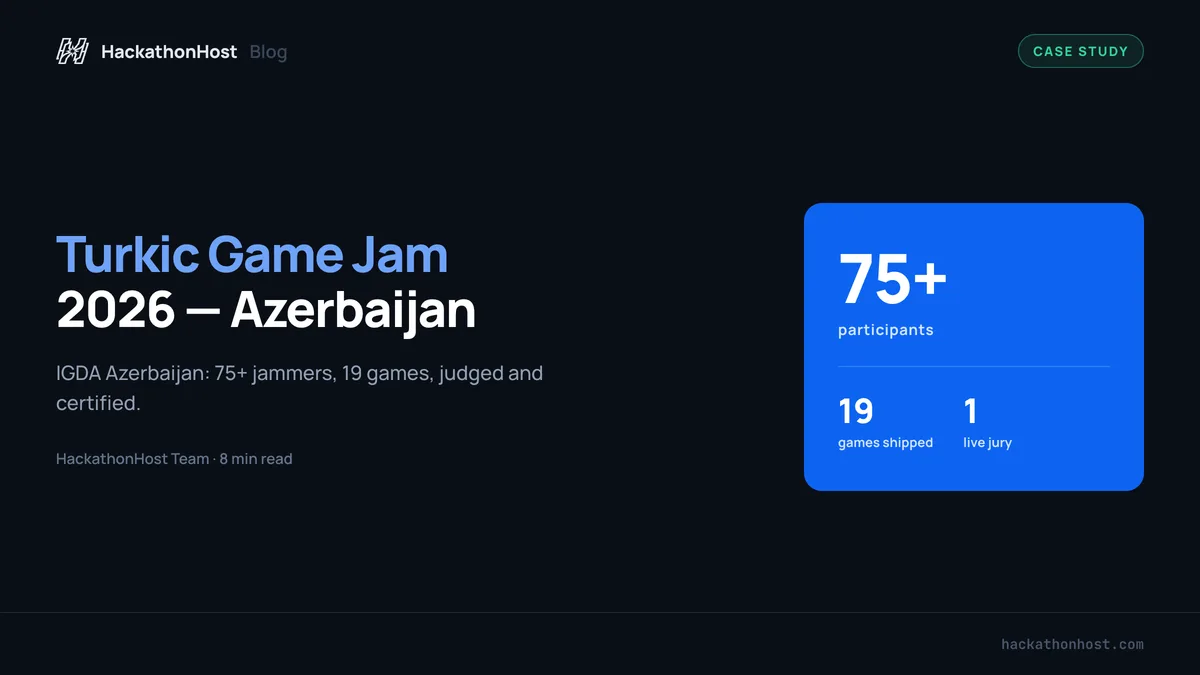
| Scale | 75+ participants · 19 games · 5–6 mentors · 4 coordinators · 3 jury · 1 guest |
| Platform | HackathonHost |
| Showcase | hackathonhost.com/events/turkic-game-jam-2026-azerbaijan |
| Games | itch.io/jam/turkic-game-jam-2026 |
See it live: the full event showcase — teams, themes, results, and gallery — is at hackathonhost.com/events/turkic-game-jam-2026-azerbaijan.
Background
Turkic Game Jam is a pan-Turkic game development competition connecting developers across Azerbaijan, Türkiye, Kazakhstan, Uzbekistan, Hungary, Northern Cyprus, and beyond. Every local stage feeds into a Grand Finale, with teams building games rooted in shared Turkic cultural heritage. The themes for the 2026 edition — Ceremony, Nomad, Knot, Sky, Fire — were designed to push participants toward work that felt culturally grounded, not generic.
The Azerbaijan stage was organized by IGDA Azerbaijan and Gamepons. 48 hours. 75+ participants across teams of varying experience levels. 19 games finished and submitted.
On paper, that's a lot to coordinate. In practice, it used to be even harder.
The problem with Google Forms and spreadsheets
Before HackathonHost, organizing a jam at this scale meant stitching together a stack of tools that were never designed to work together.
Registration happened in Google Forms. Responses landed in a spreadsheet. Someone had to manually sort teams, assign roles, follow up on incomplete entries, and keep a separate sheet for mentors and jury. Every time something changed — a team member dropped out, someone joined late, a mentor became unavailable — it meant finding the right row in the right tab and updating it by hand.
Judging was worse. Jury members received scoring sheets by email or filled out separate forms. Results had to be compiled manually, criteria weighted by hand, and if two jury members scored on different scales or skipped a criterion, it required back-and-forth to reconcile. There was no live view. No one could see where things stood until everything was collected and processed.
Submissions were fragmented. Teams submitted via form, via email, via direct message — whatever felt easiest to them. Coordinators spent time chasing down missing links, verifying formats, and hunting for builds that were sent to the wrong person.
Certificates were generated one by one. Someone exported names from a spreadsheet, dropped them into a template, exported as PDF, and sent individually. For 75+ participants across different roles — participants, mentors, jury, coordinators — that's a significant manual effort for something that should be automatic.
And through all of this, coordinators had no central view. No way to see, at a glance, how many teams had registered, who had submitted, which jury scores were still missing. Everything lived in separate tabs, inboxes, and shared drives.
It worked. But it was fragile, time-consuming, and entirely dependent on whoever was managing the spreadsheet at any given moment.
Enter HackathonHost
Turkic Game Jam 2026 — Azerbaijan was the first large-scale event run entirely on HackathonHost, an end-to-end platform built specifically for hackathons, game jams, and team competitions.
The goal wasn't to add more tools. It was to remove the coordination overhead so the organizers could focus on the event itself.
Here's how each problem got solved.
Registration: one flow, all roles
Registration on HackathonHost is role-aware from the start. Participants, mentors, jury members, and coordinators each go through the right onboarding flow — no manual sorting, no "wait, are you joining as a team or as a mentor?" back-and-forth.
For Turkic Game Jam 2026, this meant:
- 75+ participants registered and were automatically assigned to the participant role
- 5–6 mentors had their own registration path with relevant fields
- 3 jury members were onboarded with access scoped specifically to judging tools
- 4 coordinators had full organizer-level access to manage the event
Teams self-organized within the platform. Participants could form teams, invite members, and manage their lineup without coordinator involvement. When someone joined late or a team restructured mid-jam, it updated in real time — no spreadsheet rows to hunt down.
Every registered user was visible in a single dashboard. Not across five tabs. One view.
Submissions: centralized, tracked, no chasing
Submission management is one of the areas where fragmented tooling creates the most headaches. Teams submit from wherever is convenient for them, and organizers spend hours reconciling what came in, what's missing, and what format things arrived in.
HackathonHost centralizes this entirely. Teams submit their games directly through the platform — builds, links, descriptions, screenshots. Coordinators can see submission status in real time: who has submitted, who hasn't, and when submissions came in.
For the Azerbaijan stage, all 19 submitted games went through the platform. No missing links. No builds lost in inboxes. No coordinators manually chasing teams as the deadline approached.
The jam ran 48 hours. In that window, coordinators had enough to focus on without hunting down submissions.
Jury scoring: weighted criteria, per-game feedback, live results
Judging at a 19-game jam is a real coordination challenge — especially when you want scoring to be consistent, transparent, and fast to compile.
The old way: jury members fill out separate forms, results get collected after judging ends, someone manually applies weights, and the final scores take time to produce. If a jury member skipped a criterion or used a different scale, it's a problem to fix after the fact.
HackathonHost's scoring system works differently. Before judging begins, organizers define the criteria and their weights. Every jury member scores against the same rubric, in the same interface. The platform applies weighting automatically and aggregates scores in real time.
For Turkic Game Jam 2026, Nikita, Shahmur, and Tahir each scored all 19 games through the platform. They could leave per-criteria feedback alongside their scores, giving teams something actionable rather than a number. As scores came in, the leaderboard updated live — coordinators could see completion in real time and nudge anyone who hadn't finished.
Final results were ready immediately after judging closed. No compilation. No reconciliation. No waiting.
"Scoring 19 games back-to-back is a lot to hold in your head. What I liked about HackathonHost is that you could go back, compare your scores across games, and adjust before finalizing. That kind of flexibility makes the feedback more honest — you're not locked into your first impression."
— Tahir Yagublu, Jury Member, Turkic Game Jam 2026 Azerbaijan
"I also want to highlight an incredible tool that made the entire experience seamless — HackathonHost.com, a platform built by a local team and already used at its second game jam. The system fully streamlines and centralizes the hackathon process: from team registration and data collection to jury voting — ensuring complete transparency and ease of evaluation. As a two-time jury member using this platform, I can say I'm genuinely impressed."
— Nikita Yudin, Project Lead at Xsolla, Jury Member, Turkic Game Jam 2026 Azerbaijan
Automated certificate generation
Certificates sound simple until you're generating 80+ of them.
Every participant, mentor, jury member, and coordinator at Turkic Game Jam 2026 received a certificate. That's: 75+ participants, 5–6 mentors, 3 jury members, 4 coordinators, and 1 guest. Different roles, different certificate content, each one personalized with the recipient's name and contribution.
HackathonHost generated all of them automatically at the close of the event. No one opened a design template. No one exported a list of names. No one sent 80 individual emails.
Certificates were generated from the event data already in the system, rendered with the correct details for each role, and made available for download. What used to take hours — or get deprioritized entirely — was done before the cleanup crew arrived.
The live control cockpit
One detail that's easy to overlook but made a real difference during the jam itself: coordinators had a live control view throughout the 48 hours.
Timer countdowns visible to participants. Submission status across all teams. Announcement broadcasts to all registered users without switching to a separate email tool. During a 48-hour event where a lot happens simultaneously — teams forming late, mentors rotating, deadlines approaching — having one place to see the state of the whole event matters.
For 4 coordinators managing 75+ participants across two days, that kind of visibility is the difference between proactive coordination and reactive firefighting.
By the numbers
| Metric | Result |
|---|---|
| Participants | 75+ |
| Games submitted | 19 |
| Mentors | 5–6 |
| Coordinators | 4 |
| Jury members | 3 |
| Event duration | 48 hours |
| Certificates generated | 80+ (auto) |
| Spreadsheets used | 0 |
What it meant for the organizers
Running a 48-hour jam with 75+ people is genuinely hard. There's no version of it that's easy. But there's a meaningful difference between hard because the event itself is demanding, and hard because your tooling is fighting you.
With Google Forms and spreadsheets, a big chunk of coordinator energy goes into data management — moving information from one place to another, reconciling inconsistencies, hunting down missing pieces. That's time and attention that isn't going into the actual event: the participant experience, the mentoring, the energy of the room.
HackathonHost removed most of that overhead. Registrations were self-serve. Submissions were centralized. Judging ran without coordination. Certificates generated automatically.
The coordinators still worked hard. They just worked on the event, not around it.
About HackathonHost
HackathonHost is an end-to-end platform for running hackathons, game jams, and team competitions. It handles registration, team management, submissions, jury scoring, live event control, certificate generation, and more — all in one place.
If you organize jams or hackathons, explore the platform or view the Turkic Game Jam 2026 event page to see how it runs in practice.
Every edition of this jam, past and upcoming, is collected on the Turkic Game Jam series page — teams, countries, participants and results across all of them.
Running a hackathon or game jam of your own? HackathonHost handles it end-to-end — see how it works and what it costs. New to organizing? Start with how to run a game jam and hackathon judging criteria.