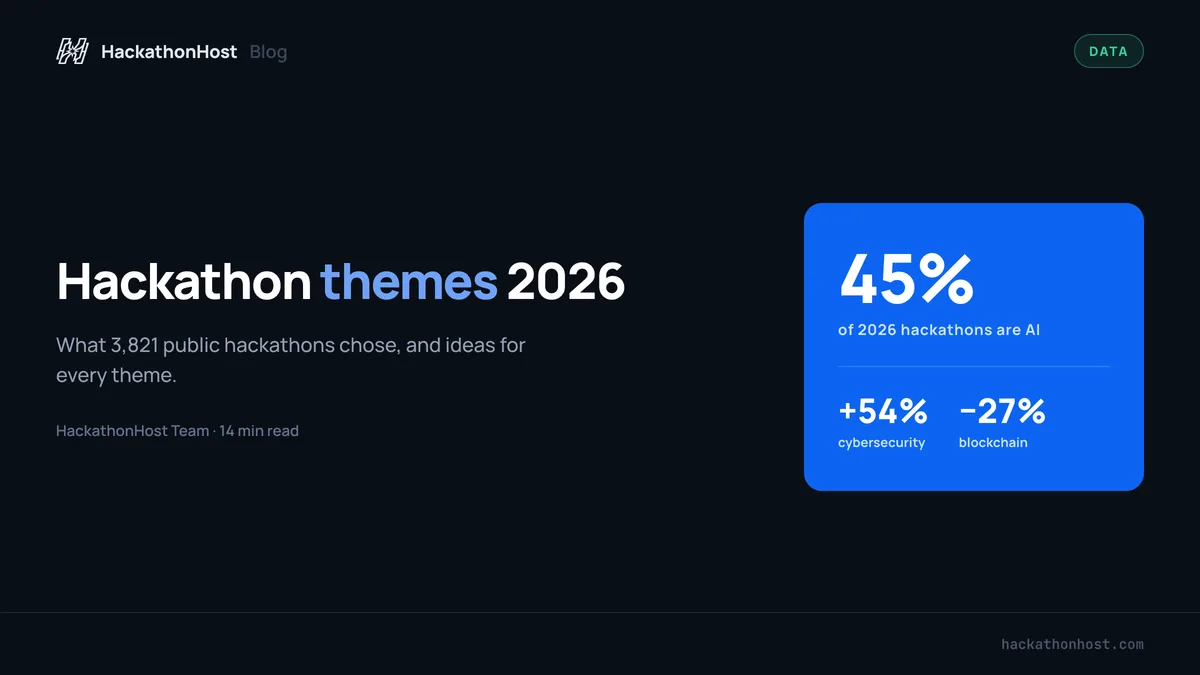
The top hackathon themes in 2026 are AI (on 45% of public hackathons), education, web, social good, and a fast-rising group of practical themes: cybersecurity, enterprise, developer tools and productivity. Blockchain is the theme in steepest decline. We know this because we counted. We pulled every public hackathon listed on Devpost with a deadline in 2025 or 2026, 3,821 events in all, and compared which themes their organizers chose.
This guide is written for the people choosing a theme, not entering one. Each theme below comes with what the data says, who it suits, and example problem statements you can put in a brief. If you are a participant looking for a project, the ideas work just as well from the other side of the table.
Top hackathon themes of 2026 at a glance
| Rank | Theme | Share of 2026 hackathons | Change vs 2025 |
|---|---|---|---|
| 1 | AI and machine learning | 44.9% | up from 39.6% |
| 2 | Education | 17.1% | up from 16.6% |
| 3 | Web | 15.9% | up from 15.3% |
| 4 | Low-code and no-code | 9.4% | flat |
| 5 | Design | 9.1% | up from 8.3% |
| 6 | Health | 6.8% | flat (6.6%) |
| 7 | Productivity | 5.7% | up 37% |
| 8 | Fintech | 5.3% | flat (5.1%) |
| 9 | IoT and hardware | 5.1% | up 18% |
| 10 | Cybersecurity | 5.0% | up 54% |
| 11 | Enterprise | 3.9% | up 58% |
| 12 | Gaming | 3.8% | up 14% |
| 13 | Blockchain | 3.4% | down 27% |
The table leaves out the three umbrella labels that sit on top of everything else: Beginner Friendly (53.5% of 2026 hackathons), Open Ended (23.0%) and Social Good (22.9%). They describe who an event is for rather than what it is about, and all three shrank slightly as organizers got more specific. The method is at the end of the article.
What changed between 2025 and 2026
Four shifts stand out in the numbers.
AI went from a theme to a default. In 2025, 39.6% of public hackathons carried the AI tag. In 2026 it is 44.9%, or 887 of 1,977 events. Among the AI-tagged events, the most common second tag is Beginner Friendly. AI is no longer the advanced track; it is what first-timers are expected to use. The word "agent" or "agentic" in an event's own name also rose, from 2.6% of hackathons to 3.4%, with three months of 2026 still to go.
The practical themes grew fastest. Enterprise (+58%), cybersecurity (+54%), DevOps (+41%) and productivity (+37%) were the four fastest-growing themes. Organizers are asking for software that does a job inside a company, and for the security work that has to come with it once AI is writing and running code.
Blockchain and mobile cooled. Blockchain fell from 4.7% to 3.4% of hackathons, and hackathons with "Web3", "crypto" or "chain" in their name more than halved. Mobile fell from 3.3% to 2.6%. Neither is dead, but neither is where the energy is.
Hackathons are moving back into rooms. Online events were 34.9% of the 2025 total and 31.9% of 2026. The pandemic-era default of fully remote is slowly giving way to in-person and hybrid events.
One more number for anyone planning attendance. The median 2026 hackathon drew 62 registrations. By theme, enterprise (93), social good (82), open-ended (81) and AI (79) events drew the most. Gaming and IoT events drew 46, and design events 41. Narrow themes attract smaller, more committed crowds, so a niche theme with a median turnout can be a good result rather than a failure.
Hackathon theme vs track vs problem statement
These three terms get mixed up, and the difference matters when you write the brief.
- A theme is the umbrella for the whole event: "AI for healthcare", "Build for your city". It sets the mood and filters who signs up.
- A track is a lane inside the event, usually with its own prize and sometimes its own judges: a beginner track, a sponsor's API track, a hardware track.
- A problem statement is a specific challenge teams solve: "Cut the time a nurse spends on shift handover notes." Corporate and government hackathons rely on them, because they want answers to their own problems.
Most strong events in 2026 combine all three: one broad theme, three to five tracks, and one or two problem statements per track.
The 12 hackathon themes worth running in 2026
1. AI agents that finish a task
The 2025 AI hackathon produced a lot of chatbots. The 2026 version asks for agents: software that plans, calls tools and completes a multi-step job with little hand-holding. Agent-named hackathons this year include enterprise events run with major cloud vendors as well as student events, so the theme works at both levels.
The trap is a theme so broad it gets 40 near-identical assistants. Name the job, not the technology.
Example problem statements:
- An agent that turns a messy inbox of supplier invoices into approved, filed payments.
- An agent that watches public job and grant portals and drafts applications for a specific user.
- An agent that triages incoming support tickets and resolves the ones it safely can.
Judging tip: ask teams to show the agent failing gracefully, not just succeeding. Reliability is what separates an agent from a demo.
2. AI for a specific field
Leaving aside the umbrella labels, the subjects most often paired with AI in 2026 were web, education, IoT and health. "AI for X" works when X is narrow enough that judges can tell whether the result would help. "AI for good" alone usually is not.
Example problem statements:
- A tool that explains a lab report to a patient in plain language, with a clear line on what it will not answer.
- A tutor that grades a photographed handwritten exercise and shows the student the first wrong step.
- A crop disease detector that works offline on a cheap phone.
3. Cybersecurity and AI safety
Cybersecurity was the second-fastest-growing theme of 2026. The 2026 lineup includes financial-sector security challenges, national-security hackathons and many student cyber events. AI makes the theme more pressing: agents that run code and touch data need guardrails, and that is a good brief for a hackathon.
Example problem statements:
- Detect a phishing message aimed at a specific organization's staff, using only public information about it.
- Find and fix the prompt-injection paths in a sample AI assistant.
- Build a dashboard that tells a small business, in plain language, what an attacker can see about it.
Capture-the-flag events fit here too, though they are scored by points rather than by a jury.
4. Productivity and internal tools
Productivity grew 37%, and productivity-tagged hackathons drew the largest crowds on average, mostly because of big sponsored online challenges. For an internal hackathon this is the most useful theme there is, because employees already know which tasks waste their week.
Example problem statements:
- Automate the weekly report someone in the team builds by hand.
- Turn meeting recordings into decisions, owners and deadlines, posted where the team already works.
- Build the internal search the company wishes it had.
Our guide to successful internal hackathon examples covers how to turn these into projects leadership will fund.
5. Enterprise and industry challenges
Enterprise was the fastest-growing theme of 2026, up 58%. These are sponsor- or company-led hackathons with real problem statements and often real data. One large 2026 corporate hackathon set challenges by sector, such as utilities, insurance, banking, manufacturing and life sciences, with a separate track for building agents.
The success factor is access: a named problem owner, a sample dataset and a promise that winning teams get a meeting with someone who can say yes. See how to run a corporate hackathon for the setup.
6. Developer tools and DevOps
DevOps grew 41%. Developers are building for developers again: tooling, testing, deployment and observability, often around a sponsor's API or platform. This theme suits developer-relations teams that want feedback on their product as much as projects.
Example problem statements:
- A CLI that explains why a failed CI run failed.
- A test generator for a sponsor's API that catches breaking changes.
- A cost dashboard that shows which feature is burning a cloud budget.
7. Education and learning
Education is on 17.1% of 2026 hackathons, more than any theme except AI. It suits schools, universities and youth events, because every participant is an expert user of the problem.
Example problem statements:
- A study-group matcher that pairs students by course and free time.
- A tool that turns a lecture recording into a set of practice questions.
- An accessible version of a university's course catalog for screen-reader users.
Running one at a university? Universities can host three free events a year on HackathonHost.
8. Health and wellbeing
Health held steady at about 7% of hackathons in both years. 2026 health hackathons range from university health hacks to on-device AI for healthcare and climate-and-health crossovers. The theme draws a smaller crowd (median 54 registrations) but a committed one, often with clinicians in the room.
Bring domain experts as mentors, and say up front what data teams may use. Synthetic or public datasets keep everyone clear of patient-privacy problems.
9. Climate, sustainability and food
Climate does not appear on the chart because Devpost has no climate tag. It hides inside social good, IoT and open-ended events, and in event names such as "Hack Away Hunger" and "Health in Climate". It remains a staple of university and city hackathons, and hardware or open data makes it much stronger.
Example problem statements:
- Show a household its real energy use from a smart-meter export, and one change worth making.
- Match surplus food from local shops to shelters before it spoils.
- Map urban heat islands from public satellite data, block by block.
10. Hardware, IoT and on-device AI
IoT grew 18% in 2026, helped by models small enough to run on a phone or a board. Hardware hackathons need more planning (equipment, power, a lending desk) but produce the most memorable demos. Cap the hardware track by the kit you have; our guide to capacity limits explains how.
11. Games and interactive media
Gaming grew 14%. If the event is about making games, run it as a game jam: a one-word theme revealed at kickoff, a playable build as the submission, and criteria that reward fun. Our list of 50 game jam theme ideas and the game jam judging criteria cover both. For the differences between the formats, see game jam vs hackathon.
12. Fintech and financial inclusion
Fintech holds steady at about 5% of hackathons. In 2026 it has moved away from tokens and toward everyday money problems, often with a bank or payments company sponsoring.
Example problem statements:
- A bill splitter that settles up in one tap across different payment apps.
- A tool that explains a loan offer's real total cost before someone signs.
- Spot unusual transactions for a small business without a finance team.
A theme to handle with care: blockchain
Blockchain fell 27% in 2026. The judges who remain ask one question: why does this need a blockchain? If your sponsor is a chain or protocol, run it as a sponsor track with that question built into the criteria. Do not make it the theme of a general event.
How to choose a hackathon theme
- Start from the goal. A recruiting event wants a theme that shows off skills. A corporate event wants a theme that produces fundable ideas. A community event wants one that brings people back.
- Match the theme to who will come. Beginners need a theme they understand without a briefing. Professionals want a problem they cannot solve at work.
- Name a user or a job, not a technology. "Help first-year students find their way around campus" beats "Build with AI".
- Check what you can support. A hardware theme needs kit, a health theme needs experts, an enterprise theme needs data. A theme you cannot support is just a slogan.
- Write the criteria at the same time. If the theme is "agents that finish a task", the rubric should reward reliability. Our free judging criteria builder builds a weighted rubric in a few minutes.
- Keep one open track. About a quarter of 2026 hackathons were open-ended. An open track catches the best idea that does not fit your theme.
- Decide when to reveal it. Corporate and problem-statement events publish the theme early so teams can prepare. Game jams and many student events keep it secret until kickoff. For a remote event, our guide to online hackathon formats covers how the timing changes.
How to write the theme brief
A theme brief is the page every participant reads at kickoff. Keep it to one screen:
- The theme in one line, plus two sentences on why it matters.
- The tracks, each with its prize and any sponsor requirement.
- Two or three example problem statements to get stuck teams moving.
- What is allowed: datasets, APIs, AI tools, pre-existing code.
- How it will be judged, with the weights.
- What to submit, and the deadline with the time zone.
Published with the rules, the brief settles most arguments before they start. For the rest of the planning, see how to host a hackathon.
How we counted
We collected every public hackathon listed on Devpost with a submission deadline in 2025 (1,844 events) or 2026 (1,977 events, including open and upcoming ones as of October 8, 2026). The themes are the tags each organizer chose when listing the event. A hackathon can carry several (2.6 on average), so shares add up to more than 100%. Devpost is one platform and leans toward North American and online events, so read these numbers as the direction of travel, not a census. Event names were matched for keywords such as "agent" and "Web3" to catch trends the tags miss.
FAQ
What are the most popular hackathon themes in 2026? AI and machine learning, on 44.9% of public hackathons, then education (17.1%), web (15.9%), low-code (9.4%) and design (9.1%). Beginner-friendly, open-ended and social-good events are also common, but those labels describe the audience more than the topic.
What hackathon themes are growing fastest? Enterprise (+58%), cybersecurity (+54%), DevOps (+41%) and productivity (+37%), measured as a share of all public hackathons from 2025 to 2026. AI grew from 39.6% to 44.9%.
Are blockchain hackathons still popular? Less than before. Blockchain fell from 4.7% of public hackathons in 2025 to 3.4% in 2026, and events with Web3 or crypto in their name more than halved. It works best as a sponsor track rather than as the theme of a general event.
What is a good hackathon theme for beginners? One that names a familiar user and problem, such as campus life, study tools, local services or personal finance, with AI allowed as a tool. Avoid themes that need specialist knowledge or hardware to get started.
What is the difference between a hackathon theme and a track? The theme is the umbrella for the whole event. Tracks are lanes inside it, usually with their own prizes, such as a beginner track or a sponsor's API track. Most events have one theme and three to five tracks.
Should every hackathon have a theme? No. About a quarter of public hackathons in 2026 were open-ended. A theme helps when you need projects that serve a goal, such as a sponsor's problem or a social cause. Open-ended suits events built for learning and community.
How many tracks should a hackathon have? Three to five for most events. Every track needs its own judges or criteria, mentors and a prize, so more tracks than your team can support spreads everyone thin.
Run any theme on HackathonHost
Whatever theme you choose, the event around it is the same: registration, teams, submissions, judging and a reveal. HackathonHost runs all of it in one workspace, including a live theme reveal with a countdown, weighted jury scoring, projector mode and QR-verified certificates. It is a flat $99 per event with no per-participant fees. Create your first event and have the theme brief live today.