A polished project with a large friend network can win a public vote while a technically difficult, high-impact build finishes mid-table. That result is not automatically wrong. But it is exactly why public voting vs jury scoring must be decided as an event-design choice, not as a last-minute feature toggle.
For hackathons, game jams, and innovation challenges, the scoring model shapes participant behavior from the moment rules go live. It affects who enters, what teams build, how judges spend their time, and whether the final reveal feels credible. The right model depends on what you want the event to reward.
Public Voting vs Jury Scoring: The Core Difference
Public voting asks an audience to choose the project they find most appealing. That audience may include attendees, community members, sponsors, employees, players, or online viewers. It is fast, accessible, and useful when the event is meant to create energy around a community or product.
Jury scoring asks selected evaluators to assess entries against a defined rubric. Judges can review implementation quality, originality, feasibility, design, impact, and fit with the brief. This model is better suited to decisions where expert judgment and defensible criteria matter.
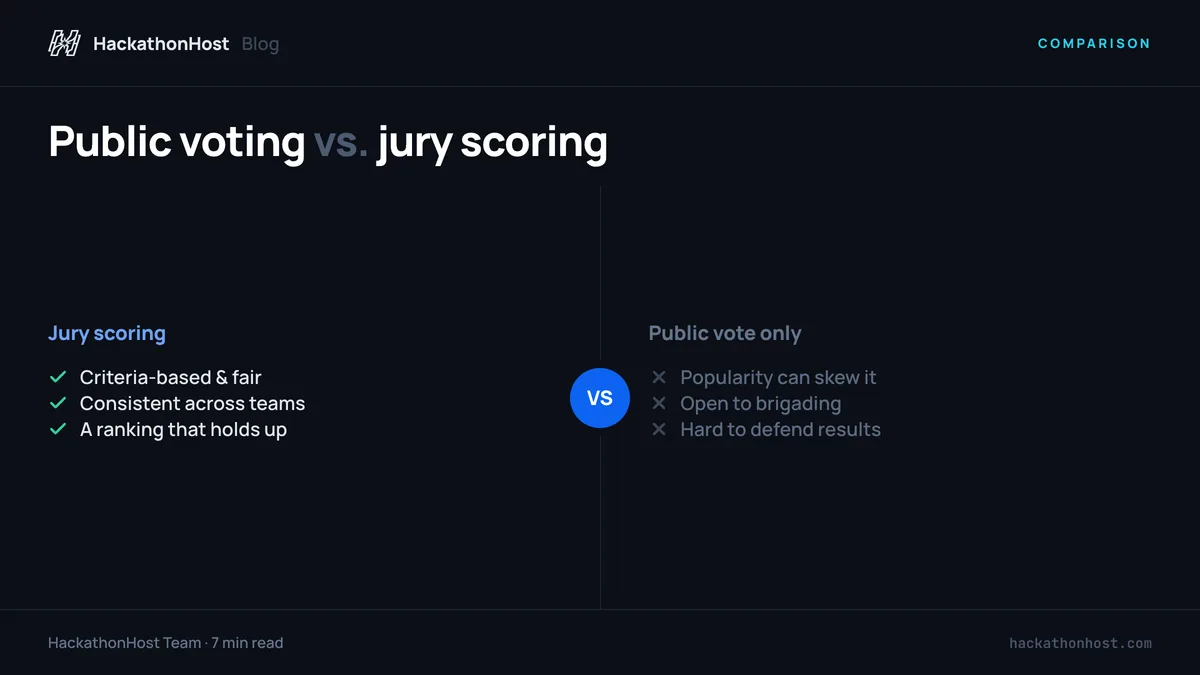
Neither approach is inherently fairer. Public voting is fair when the stated goal is audience appeal. Jury scoring is fair when the stated goal is expert evaluation against consistent standards. Problems start when organizers promise one kind of outcome but use a model that rewards another.
A game festival seeking a fan-favorite title may want the crowd to have real influence. A corporate hackathon selecting a pilot-worthy solution needs judges who can assess security, integration effort, business value, and delivery risk. The scoring method should match the prize, the audience, and the stakes.
When Public Voting Is the Right Call
Public voting works best when engagement is part of the event outcome, rather than a side benefit. It gives participants a reason to share their projects, invite peers to try them, and put extra care into demos, trailers, pitches, and presentation quality.
It can be especially effective for community showcases, game jams with playable entries, people’s-choice awards, internal demo days, and sponsor activations. A public vote also gives non-judges a role beyond watching from the sidelines. That can make a large event feel more participatory.
The trade-off is that public voting measures visibility as much as quality. Teams with established networks, stronger marketing instincts, or better timing often have an advantage. If voting is open online, organized vote campaigns and low-quality submissions can become operational concerns.
That does not make public voting unusable. It means the rules need boundaries. Require verified participants or attendees, limit each person to one vote, set a clear voting window, and state whether teams can promote their entries. If the audience vote is a separate award, label it clearly as People’s Choice rather than presenting it as the event’s overall best project.
When Jury Scoring Is the Better Fit
Jury scoring is the stronger option when winners receive meaningful funding, hiring opportunities, incubator access, contracts, or high-value prizes. In these cases, organizers need a decision process they can explain without relying on popularity.
A good jury rubric turns broad goals into observable criteria. For example, a sustainability hackathon might assess problem relevance, technical execution, potential impact, usability, and presentation. A game jam might prioritize adherence to theme, gameplay, innovation, art and audio direction, and completeness.
The rubrics should be shared before teams start building. Participants do not need every internal judging note, but they should know what success looks like. Clear criteria reduce disputes because teams can see that a project was evaluated on more than its final pitch.
Jury scoring also has trade-offs. It takes time. Judges may interpret criteria differently, miss projects during a crowded demo session, or be influenced by a charismatic presenter. A technically strong project can be underrated if the judging flow is rushed or if judges have no calibration process.
The operational fix is not more spreadsheets. It is a structured process: assign judges, define scoring ranges, collect scores in one place, flag conflicts of interest, and lock results before the reveal. Give judges enough review time and ensure every eligible project receives the same baseline attention.
The Hybrid Model: Expert Winners, Community Energy
For many organizers, the best answer is not public voting or jury scoring alone. It is a hybrid model with separate purposes.
The cleanest version uses jury scores to determine the main winners and public votes to select a separate audience award. This preserves the credibility of the top prizes while giving participants and attendees a reason to engage with every project. It also prevents a popular team from being penalized for having an enthusiastic community, while avoiding the claim that popularity alone determined the event champion.
A weighted model can work too. For example, jury scoring might represent 80% of the final score and public voting 20%. Use this only when audience appeal is genuinely relevant to the main award. If the public component exists merely to create buzz, keep it separate. Weighted scoring can be difficult to explain during a tense reveal, especially when a team wins by a narrow margin.
If you do use weighting, publish the formula in advance. State whether scores are normalized, how ties are resolved, and whether public votes are capped or verified. Hidden formulas create avoidable suspicion, even when the underlying decision was sound.
Build a Scoring Workflow That Holds Up
The choice of scoring model matters, but execution determines whether it feels professional. A reliable workflow starts before submissions open.
First, connect every award to a defined scoring source. Main prizes may use jury scores, a community award may use verified public votes, and a sponsor prize may use a dedicated sponsor judge. Avoid combining unrelated criteria after the event because the results look inconvenient.
Second, make the scorecard easy to use under event conditions. Judges should see the project details, demo links, assigned criteria, and scoring controls without switching among forms, documents, and chat messages. A scorecard that is technically complete but slow to navigate will produce rushed decisions.
Third, decide how you will manage edge cases. Your event rules should cover late submissions, incomplete projects, duplicate entries, voting eligibility, judge conflicts, score ties, and disqualification authority. These are not minor legal details. They are the controls that protect the winner announcement from confusion.
Fourth, separate the live experience from the administrative process. Participants should be able to see when voting opens, when it closes, and when results will be announced. Organizers need the ability to monitor completion, verify activity, review anomalies, and hold the leaderboard until it is ready for a proper reveal.
A purpose-built event platform such as HackathonHost can keep submissions, jury scoring, public voting, leaderboards, and reveal controls in the same event workspace. That reduces the common failure point of exporting data from multiple tools just before awards are announced.
Common Scoring Mistakes to Avoid
The most damaging mistake is treating judging as a closing ceremony task. By the time projects are submitted, the scoring structure should already be tested, judges briefed, and rules visible to participants.
Another mistake is asking the public to evaluate criteria they cannot reasonably assess. Attendees can often judge enjoyment, clarity, visual appeal, or perceived usefulness. They usually cannot verify code quality, technical complexity, or commercial feasibility from a two-minute demo. Keep expert criteria with experts.
Organizers also underestimate judge calibration. Two judges may both assign a score of eight but mean very different things by it. A short pre-event discussion with sample entries can align expectations on what a low, average, and exceptional score looks like.
Finally, do not let the leaderboard leak. Early standings can distort public voting, encourage strategic behavior, and distract teams from finishing their projects. Keep progress visible to organizers, not necessarily to every participant, until the scoring window closes.
Decide What Winning Should Mean
Before you choose a voting method, finish this sentence: “The winning project is the one that best...” The answer should be specific. Best solves a business problem. Best fits the game jam theme. Best engages the community. Best demonstrates technical depth.
That sentence will point you toward the right model. If the answer centers on expert judgment, use jury scoring. If it centers on audience response, use public voting. If both matter, give each a clear, visible role rather than forcing them into a confusing compromise.
A strong winner reveal is not created by dramatic visuals alone. It comes from participants believing the process reflected the event they signed up for.